AI-generated text
US Navy’s ShipOS AI Platform Accelerates Submarine Production
Industry · May 15, 2026
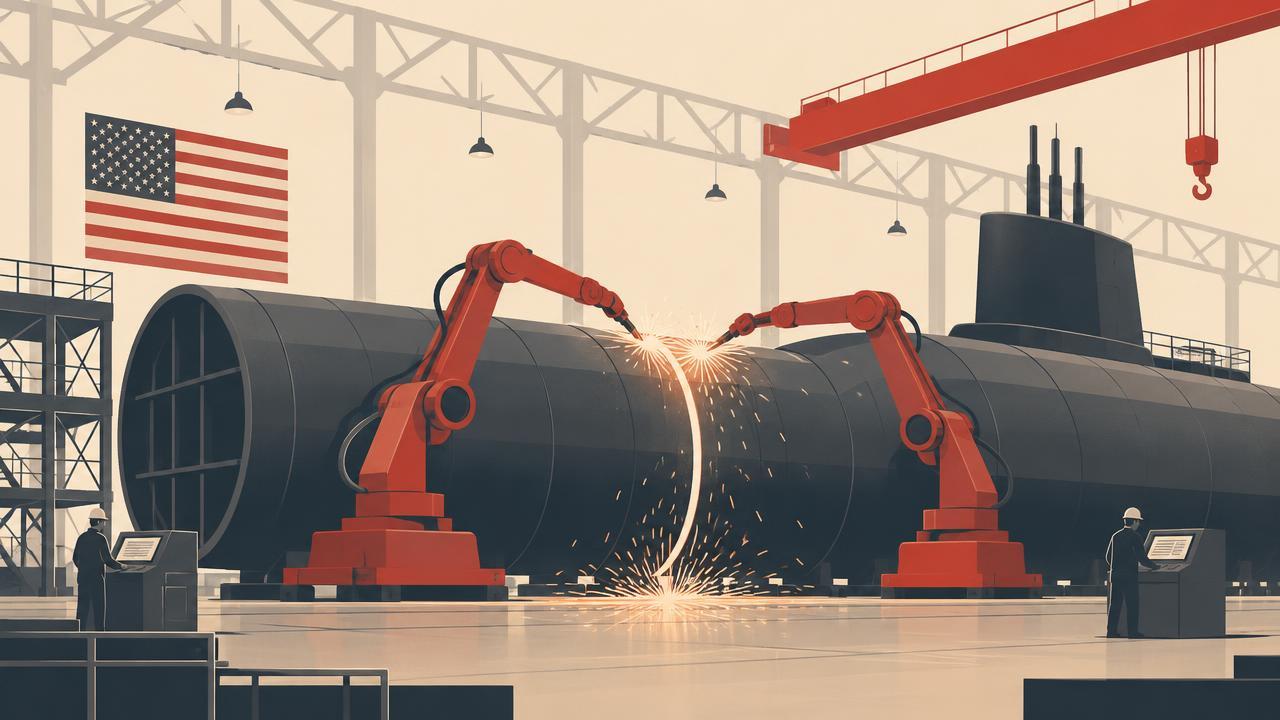
The US Navy has deployed ShipOS, an AI-driven production-management platform launched in December 2025 to speed construction and maintenance of Columbia- and Virginia-class submarines.
In this article · 3
The US Navy has deployed a new artificial-intelligence-based production-management system to accelerate submarine construction and maintenance. The platform, called ShipOS, was launched in December 2025 with federal funding, according to the US shipbuilding plan published in May 2026.
The development was carried out under the "One Big Beautiful Bill Act," which aims to modernize the defense industrial base. ShipOS is initially focused on construction and sustainment of Columbia-class ballistic missile submarines and Virginia-class attack submarines. The Navy has identified undersea warfare as its top shipbuilding priority and aims to reach an annual production rate of one Columbia and two Virginia-class boats by 2031.
Trial results and efficiency gains
Key figures published in the plan highlight substantial efficiency improvements during trial operations. The Navy reports that ShipOS reduced scheduling time for submarine construction from 160 work-hours to under ten minutes. Simultaneously, material-inspection lead time was cut from several weeks to less than an hour. Pentagon officials have described the system as a "production warfare tool."
What data it processes and what it does
Unlike traditional shipyard software, ShipOS aggregates large volumes of production data into a single, real-time industrial picture. The platform integrates data from shipbuilders, suppliers and logistics networks, and ingests enterprise resource planning systems, legacy databases, shop-floor resources, and even information contained in emails and spreadsheets.
The embedded artificial intelligence continuously monitors the entire submarine production chain: it analyzes raw material prices, supplier performance, labor utilization, machine capacity and inventory flows. ShipOS can identify production bottlenecks and scheduling risks, providing end-to-end visibility from senior Pentagon leadership down to the workshop floor.
Why this matters
The introduction of ShipOS responds to increased geopolitical pressure: the Navy’s modernization efforts are partly driven by a rising maritime arms competition with China and shifting balances of power. The platform’s deployment and trial performance promise significant operational and logistical efficiencies that directly support the Navy’s stated production targets.
Tags: China, artificial intelligence, automation, Pentagon, manufacturing, efficiency, US, 2025, US Navy, defense industry
Related articles More from the section.

SAP considers cutting more than 10,000 jobs amid AI shift
SAP is considering eliminating more than 10,000 positions as it adapts its business to artificial intelligence, according to Bloomberg.
Industry · November 26, 2026
OpenAI employee saw potential for mathematical applications of the model early on
An OpenAI employee referred to in the text as Ven believed early on that the company’s model at the time might be capable of solving the Millennium Prize Problems.
Industry · November 26, 2026
GTA VI and Anthropic IPO Highlight Debate Over AI and Creative Work
The reported launch of Grand Theft Auto VI has renewed debate over whether AI can replicate the painstaking work behind ambitious video games.
