AI-generated text
Rising Data‑centre Demand Strains Europe’s Power System
Industry · June 3, 2026
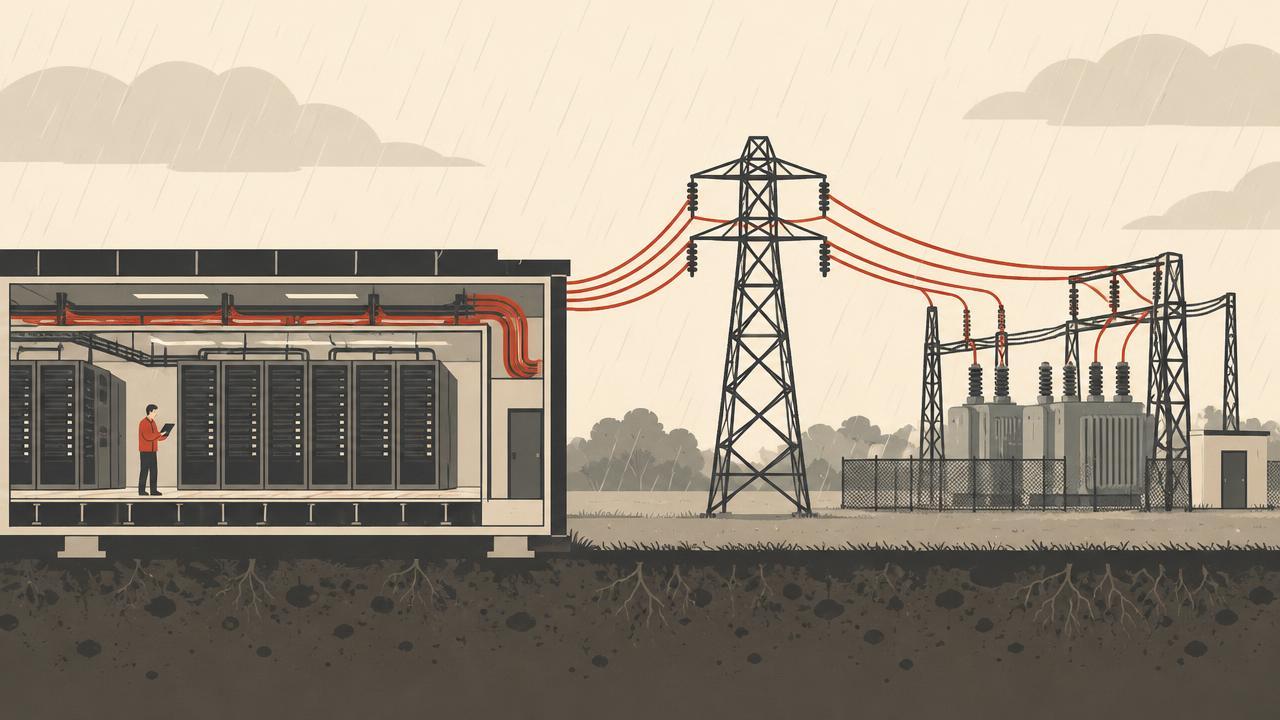
SoftBank’s planned €75 billion investment in 3.1 GW of AI data centres in northern France highlights how rapidly growing electricity demand from hyperscale computing is stressing Europe’s power networks.
In this article · 4
Japanese conglomerate SoftBank announced a €75 billion investment to build artificial‑intelligence data centres in France’s Hauts‑de‑France region. The plan covers sites in Dunkerque, Bosquel and Bouchain and totals 3.1 gigawatts of capacity to be completed by 2031. The project highlights how hyperscale AI facilities place heavy demands on European electricity networks.
France is an attractive location for such energy‑intensive projects because more than 60 percent of its electricity generation comes from nuclear power. That gives it an advantage on a continent where, according to the International Energy Agency (IEA), industrial electricity prices last year were roughly double those in the United States and about 50 percent higher than in China and India.
Nuclear power’s role and Europe’s energy mix
Analysts say the growing power needs of data centres strengthen the case for a larger role for nuclear energy in Europe. Eurostat data show, however, that nuclear accounted for only 11.8 percent of Europe’s energy mix in 2025, while oil and gas together still supplied about one‑third of overall energy needs.
Small modular reactors: promise and limits
Small modular reactors (SMRs) are drawing increasing attention from big tech. Amazon signed an agreement with Dominion Energy in 2024 to explore SMR development opportunities, and Google struck a 2025 agreement with Kairos Power and the Tennessee Valley Authority to pursue new nuclear capacity. SMRs are typically prefabricated units of under 300 megawatts that can be deployed faster and more cost‑effectively than conventional nuclear plants, whose construction often takes more than a decade. SMRs can also operate in islanded mode, independent of large transmission networks.
Nevertheless, broad deployment of SMRs faces significant obstacles. Tania Arora of the Baker McKenzie energy practice noted that data‑centre operators are reluctant to bear the risks associated with first‑generation technology, particularly since commercial SMRs currently operate only in China and Russia.
Grid capacity and skilled workforce as constraints
Beyond secure power supply, the availability of skilled labour is a decisive factor for major technology firms expanding in Europe. London is especially attractive in this respect: the Nvidia‑backed Runway recently announced it will open its European headquarters in the British capital, and Anthropic, OpenAI and Google are planning new offices there. These moves show that expansion of digital infrastructure requires both network capacity and local technical expertise.
Implications and challenges
SoftBank’s project draws attention to the need for Europe’s power systems and energy policies to adapt to rapidly growing electricity demand from AI services. The developments raise competitiveness questions for the continent, particularly if energy prices remain markedly higher than in other regions. Policymakers will need to coordinate investments in grids, consider possible nuclear capacity expansions and ensure the availability of skilled workers to meet these demands.
Related articles More from the section.

SAP considers cutting more than 10,000 jobs amid AI shift
SAP is considering eliminating more than 10,000 positions as it adapts its business to artificial intelligence, according to Bloomberg.
Industry · November 26, 2026
OpenAI employee saw potential for mathematical applications of the model early on
An OpenAI employee referred to in the text as Ven believed early on that the company’s model at the time might be capable of solving the Millennium Prize Problems.
Industry · November 26, 2026
GTA VI and Anthropic IPO Highlight Debate Over AI and Creative Work
The reported launch of Grand Theft Auto VI has renewed debate over whether AI can replicate the painstaking work behind ambitious video games.
