AI-generated text
Panthalassa raises $140M to build wave-powered floating AI data centers
Business · May 8, 2026
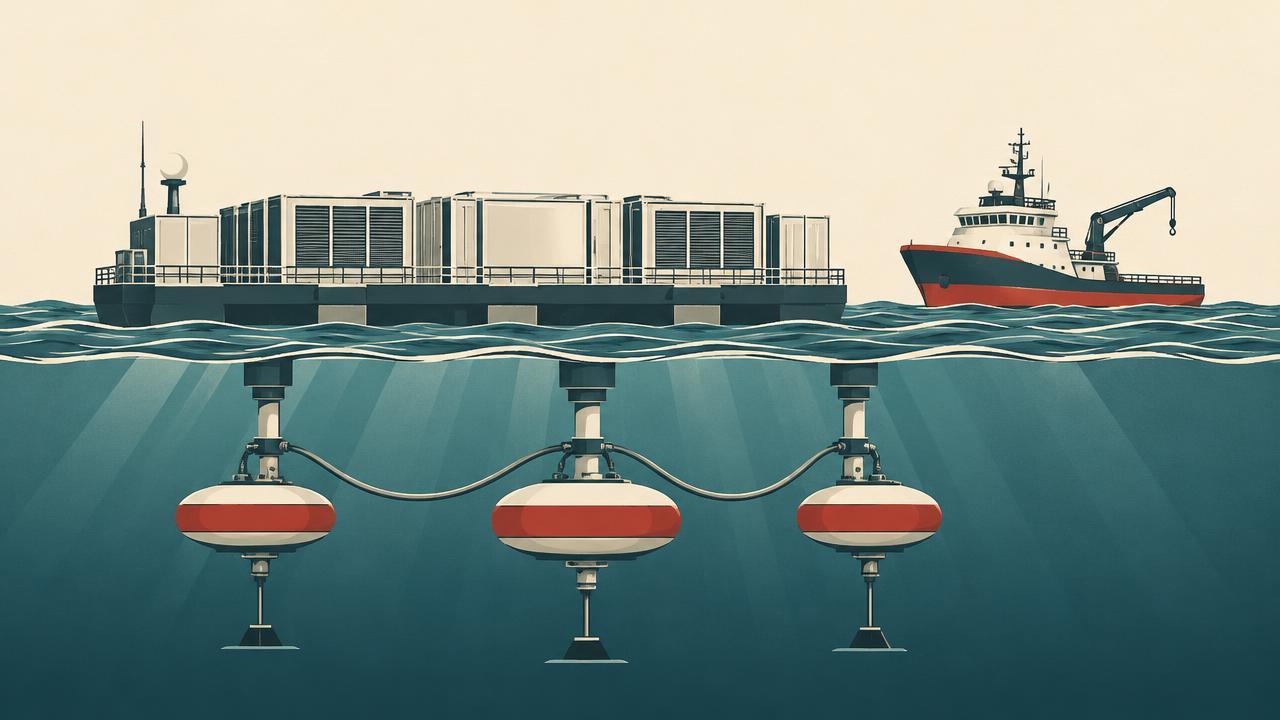
Panthalassa has secured $140 million in funding led by Peter Thiel to develop autonomous, wave-powered floating data centers—85‑metre steel spheres designed to run AI inference chips cooled by seawater and communicate via satellite.
In this article · 4
Panthalassa has secured $140 million in a funding round led by Peter Thiel; other participants include John Doerr, Marc Benioff and Founders Fund. The company is developing autonomous, wave‑powered floating data centers conceived as 85‑metre steel spheres intended to operate in the northern Pacific.
What the concept involves
- The planned units would run AI inference chips cooled by seawater.
- Instead of undersea fiber, the systems would rely on satellite communications and are designed for minimal or no human maintenance for a decade.
- Panthalassa aims to deploy Ocean‑3 pilot units later this year, with commercial operations targeted for 2027.
Why this matters now
The investment and the profile of the backers signal that constraints on land‑based data centers — especially around power and cooling — are pushing interest toward unconventional approaches. The International Energy Agency (IEA) projects that data centers will consume about 1,000 TWh globally this year, roughly equivalent to Japan’s total annual electricity consumption.
Constraints such as limited grid capacity, availability of cooling water, permitting hurdles and local opposition (NIMBYism) are converging, putting pressure on traditional data center siting and expansion.
Technical and operational challenges
Panthalassa’s approach raises several major engineering and operational questions that remain largely unproven at scale:
- Satellite throughput: satellite links generally offer less bandwidth and higher latency than fiber and may be costlier for large data transfers.
- Multi‑node coordination: operating distributed, unmanned nodes in coordination is complex.
- Saltwater corrosion and material durability: ocean environments are highly corrosive and demanding for steel structures.
- Storm survival and extreme conditions: units must withstand severe Pacific storms and other harsh ocean dynamics.
Microsoft’s earlier Project Natick (2013–2024) tested underwater data centers but was ultimately discontinued, illustrating some of the practical and economic difficulties of marine deployments.
Conclusion
That nearly a billion‑dollar valuation and high‑profile investors support a wave‑powered, satellite‑connected floating data center concept underscores how acute the electricity and infrastructure pressures around AI workloads have become. The Panthalassa plan tests whether ocean deployment can offer a viable alternative to strained terrestrial systems, but significant technical and operational risks must be resolved before the concept is proven at commercial scale.
Related articles More from the section.

Banks Seek to Transfer AI Loan Risk to Investors
Banks including Citi and JPMorgan are marketing loan portfolios as they manage their exposure to AI-related debt, according to people familiar with the deals.
Business · November 26, 2026
Nvidia Credit Outlook Shift Raises Questions for AI Financing
Moody’s has changed Nvidia’s credit outlook from positive to stable, while S&P Global has raised concerns about the departure and return of CEO Jensen Huang.
Business · November 26, 2026
Xpeng plans humanoid robot launch as it expands beyond electric cars
Chinese electric vehicle maker Xpeng plans to launch its IRON humanoid robot in the second quarter of next year, with a price comparable to a mid-range electric car.
