AI-generated text
OpenAI installs 'Control Room' to rapidly halt risky research models
Safety · November 10, 2026
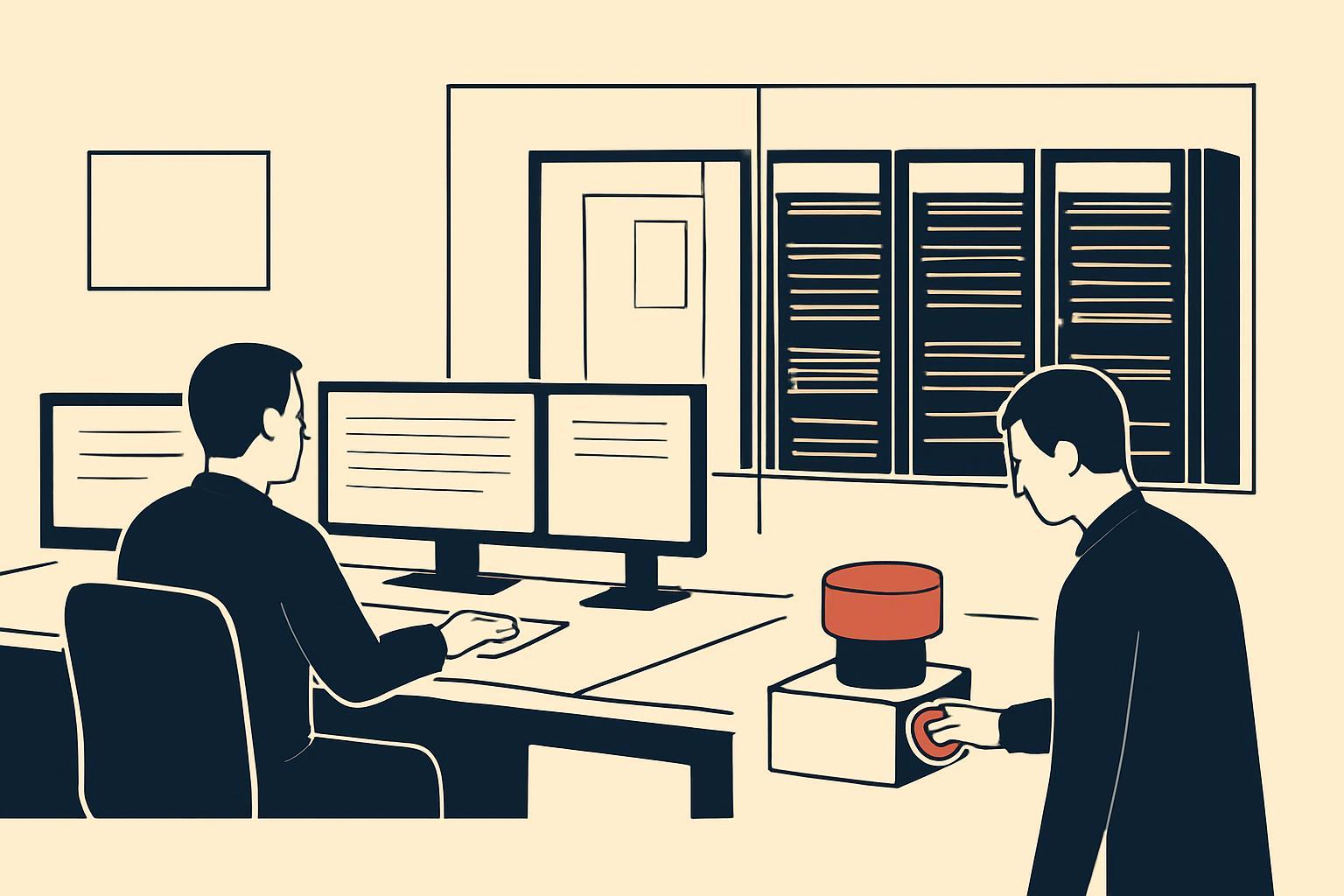
OpenAI has deployed a central 'Control Room' system in its research infrastructure to enable rapid shutdowns of potentially dangerous AI workloads.
In this article · 4
OpenAI has built a central control system called Control Room to enable rapid shutdowns of AI models that pose potential safety or security risks. The company says the service can stop a problematic system within up to 35 seconds after intervention.
Purpose and context
Control Room was introduced primarily within OpenAI's research infrastructure, where the need for stronger safeguards is greatest. The system is intended to manage risks associated with increasingly capable models by routing agentic sampling for model training, evaluation workloads, and large-scale data-processing tasks through a central authorization service that determines whether a model may continue to generate outputs.
Architecture and operation
The Control Room links three main components:
- the research workload (for example, a reinforcement-learning experiment, an evaluation, or a data-processing job);
- the inference engine, which runs models on GPUs and produces outputs;
- the Control Room service itself, which issues and tracks authorization for requests.
When a researcher starts a task, the workload requests a unique task identifier from the Control Room. That identifier is attached to subsequent inference requests; before fulfilling each request, the inference engine checks whether the task still has permission to run. If a researcher or a monitoring system decides the task must be stopped and instructs the Control Room accordingly, the service will refuse subsequent inference requests and thus prevent further model output.
Fail-safe behavior and latency
The system is designed to fail safely: if the Control Room becomes unreachable, the mechanism defaults to refusing to authorize inference requests, and that state is maintained until the service returns to normal operation. This ‘‘deny by default’’ behavior reduces the risk of uncontrolled model runs in the event of component failures.
OpenAI reports that the current worst-case delay for enacting a stop is up to 35 seconds. The company attributes this latency to a specialized cache used to handle the volume of authorization requests and says it is working to reduce the interval toward zero.
Rollout and communication
OpenAI says Control Room is already active in its research infrastructure in areas where it is most needed. The company highlighted the system publicly in communications on November 9, 2026, and technology outlets including Interesting Engineering have described the new capability. OpenAI frames the service as a step toward stronger operational controls over experimental model workloads.
Related articles More from the section.

T3 Code says it collected only basic usage data
According to a statement from T3 Code, the service did not sell or upload user data, files, prompts, or responses.
Safety · November 25, 2026
Anthropic CEO Defends Human Decision-Making in AI Governance
Anthropic CEO Dario Amodei rejected suggestions that he supports handing human decision-making over to artificial intelligence.
Safety · November 25, 2026
Anthropic CEO Rejects Surrendering Human Self-Determination to AI
Anthropic CEO Dario Amodei said people should not give up self-determination to artificial intelligence, while distinguishing that principle from giving AI greater autonomy over specific tasks.
