AI-generated text
Home Genomics Reaches a 'Garage-Computer' Moment
Tools · May 8, 2026
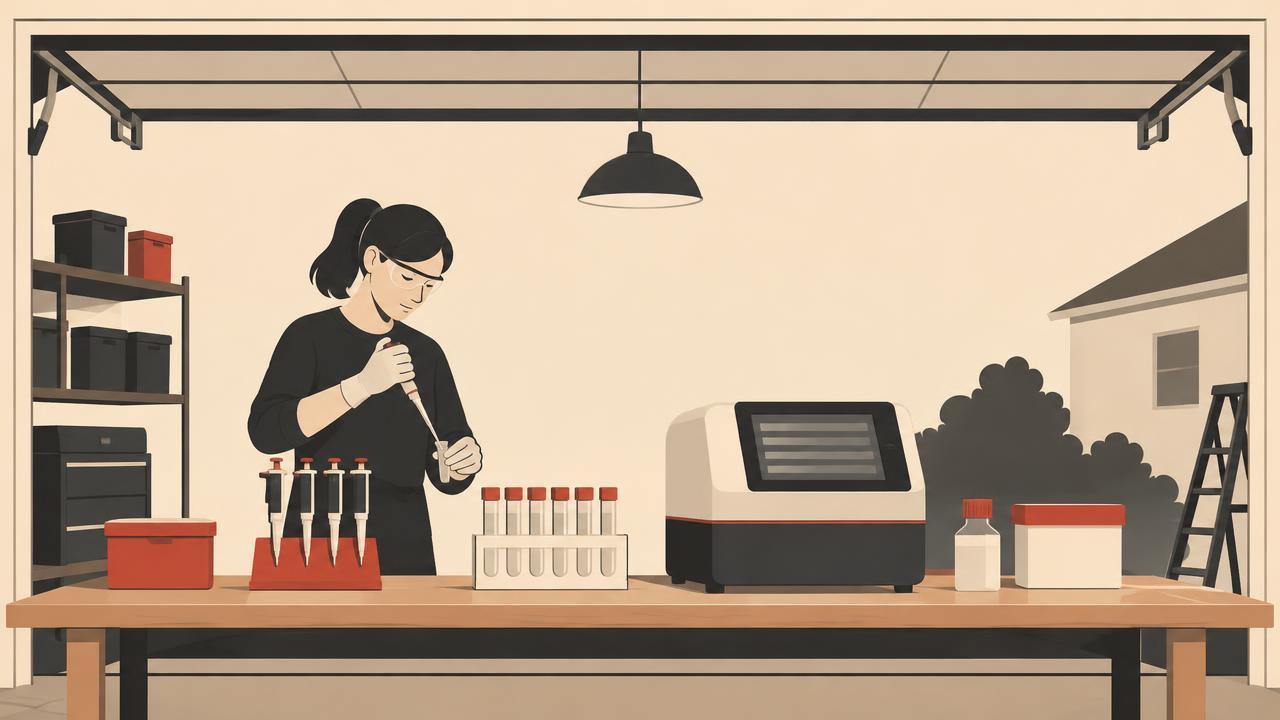
Seth Howes, an engineer and medical researcher, sequenced his own genome in a home wet lab using an Oxford Nanopore MinION and AI tools such as Claude, Evo2, and AlphaGenome for analysis, reporting a cost of about $1,100.
In this article · 3
Seth Howes, a young engineer and medical researcher, has drawn viral attention after sequencing his own genome in a home wet lab. He used an Oxford Nanopore MinION to read his DNA, and relied on AI and genomic analysis tools including Claude, Evo2, and AlphaGenome to process and interpret the data. Howes reported the total cost at roughly $1,100.
What matters and why
Institutional sequencing already costs from several hundred to a few thousand dollars, so the price alone is not the disruptive factor. The key issue is repeatability: if an individual can reconstruct the entire workflow at home, keep raw genome data private, rerun analyses, change the questions being asked, and use models as the interface for interpretation, then institutions cease to be the sole source of biological truth.
This shift implies that laboratory processes become more like software-driven workflows: the physical lab’s role partially transforms, while institutions risk becoming expensive permission layers rather than exclusive knowledge authorities.
Practical and ethical considerations
The episode raises practical and regulatory concerns: data handling and security (storage and sharing of raw genomic data), validation and reproducibility of methods, and the risk of incorrect or misleading interpretation of personal health information. If home workflows become reliably repeatable, the balance of power in producing and interpreting biological knowledge is reshaped.
Implications
If living-room genomics can be consistently reproduced, institutional control over biological interpretation may weaken. Laboratories and research centers may migrate toward roles focused on supervising software-based analysis tools and models; institutions could become primarily cost and access controllers. These developments warrant attention from the scientific community, regulators, and public-health stakeholders.
Related articles More from the section.

Nothing unveils Ear (note) earbuds with AI note-taking
Nothing has introduced Ear (note), a pair of earbuds designed to transcribe and summarize conversations, calls and online meetings.
Tools · November 26, 2026
Four AI Agents Learn to Share Information Using One Language Model
An experiment trained four agents backed by a shared small language model to exchange private information and sort numbers.
Tools · November 26, 2026
Poliext Uses AI to Speed Up Meeting Follow-Up
Poliext says it has reduced the time needed to prepare meeting summaries from 30–45 minutes to half a minute to one minute using Minuteory.
