AI-generated text
Brookhaven's Electron–Ion Collider Designed Around AI from the Ground Up
Research · May 19, 2026
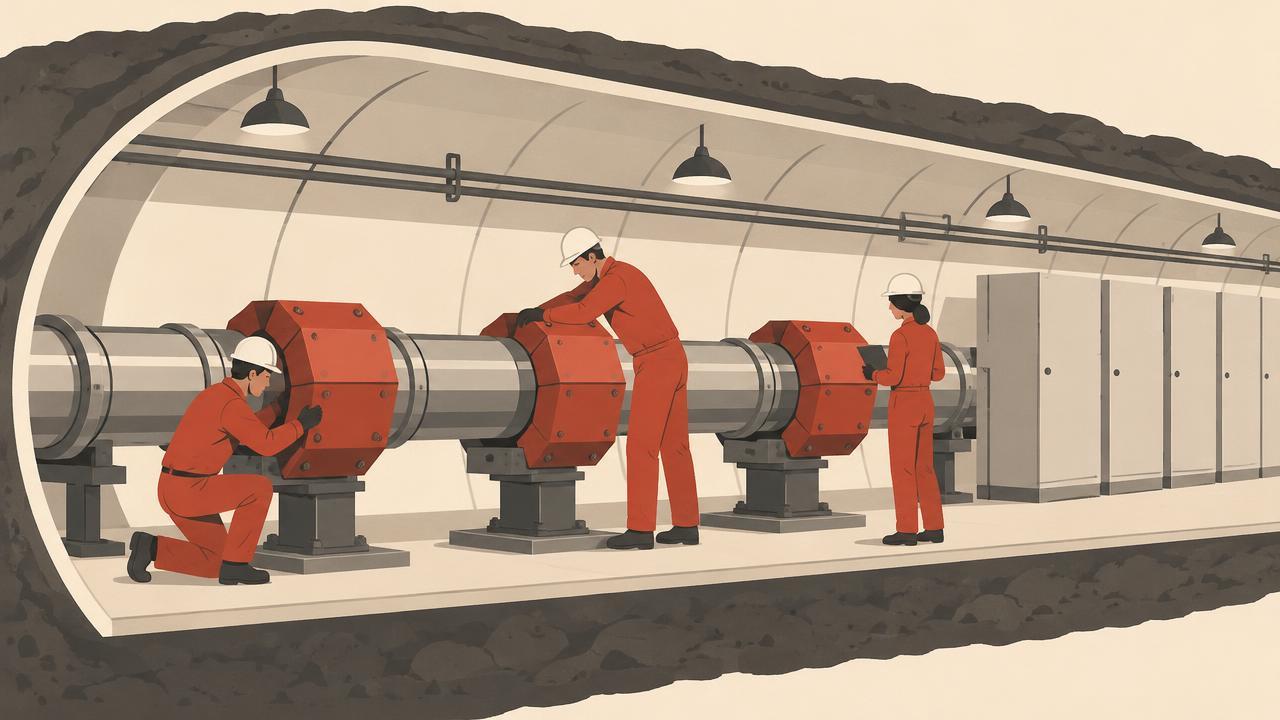
Brookhaven National Laboratory is building the Electron–Ion Collider, a $1.7–$2.8 billion, 2.4‑mile ring collider whose detector and accelerator are being designed with machine learning embedded from the start.
In this article · 5
Brookhaven National Laboratory (BNL) is constructing the Electron–Ion Collider (EIC), a new accelerator whose budget is estimated between $1.7 billion and $2.8 billion. The machine will run on a 2.4‑mile ring, and unlike previous facilities, machine learning and AI are being integrated into both the accelerator and detector design from the outset.
Technical figures and timeline
The EIC's ePIC detector is expected to record about 500,000 collisions per second and to produce roughly 100 gigabits per second of data. The project is targeted to begin operations in the mid‑2030s.
Why this is different
Historically, AI has been used mainly downstream of experiments to analyse recorded data. At the EIC, AI is treated as a design constraint: detector geometry, beam control, and data compression are being optimized with the capabilities of learning models in mind rather than solely for human readability.
Early demonstrations
The EIC‑BeamAI system has already matched expert tuners on the Relativistic Heavy Ion Collider (RHIC) pre‑accelerators. A digital twin implementation can anticipate magnet failures before they damage hardware.
Implications for research and operations
As instruments become shaped around what AI needs to observe, artificial intelligence shifts from being a tenant in the workflow to becoming an architect of the facility. The rapid growth of data volume makes AI not only an analysis tool but also a critical component of operation and design.
Summary
The Electron–Ion Collider and its ePIC detector at Brookhaven National Laboratory illustrate a turning point: AI is no longer only applied after measurements but is embedded in the steel and control systems that define what and how experiments measure. Full operation is expected in the mid‑2030s.
Related articles More from the section.

New Test Measures AI Model Performance on Long Engineering Tasks
A new study examines how AI model performance on long engineering tasks improves with the computing capacity used during testing.
Research · November 25, 2026
AI labs publish mathematical proof claims awaiting review
OpenAI and Anthropic have published AI-assisted claims on major problems in computational complexity, including the matrix multiplication exponent and the separation of VP from VNP.
Research · November 25, 2026
Register reuse speeds up NVFP4 attention on NVIDIA RTX Blackwell
A revised attention kernel reuses registers and interleaves operations to keep Tensor Cores busier on NVIDIA RTX Blackwell GPUs.
