AI-generated text
AI investment concerns and potential US tariffs weigh on stocks
Industry · November 25, 2026
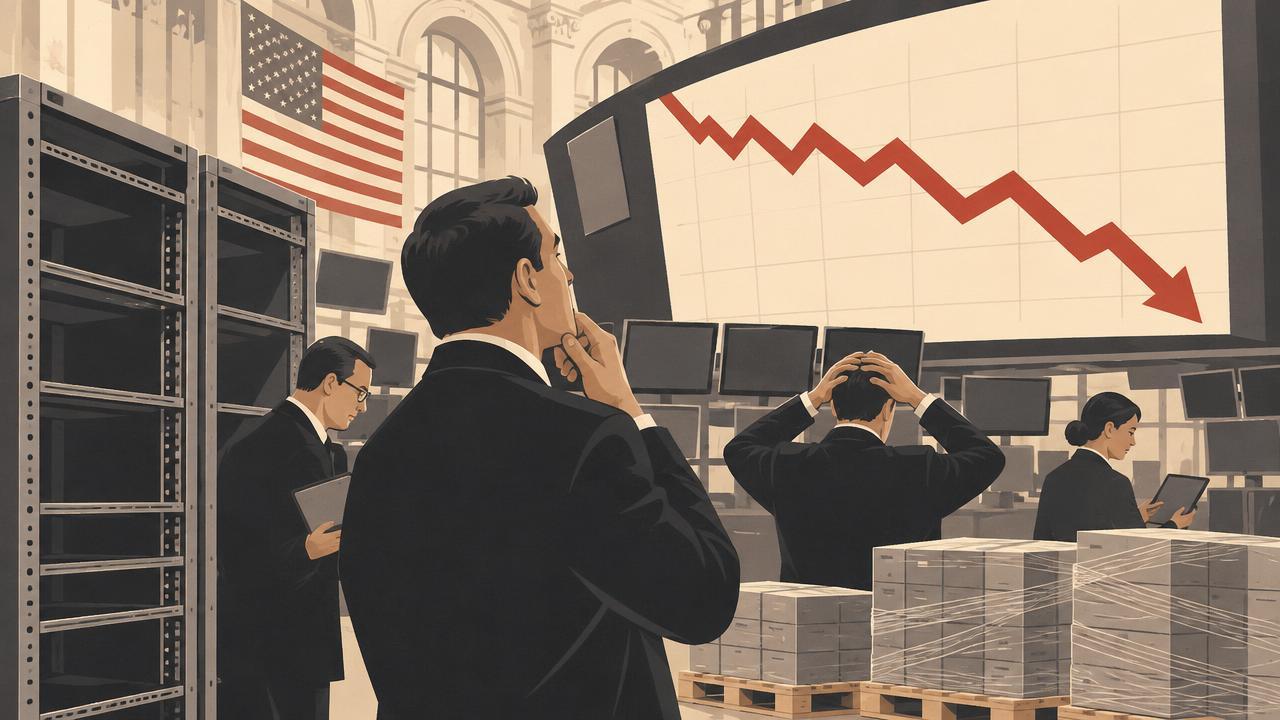
Technology shares led a broad market decline on November 25, 2026, as investors questioned the returns on artificial intelligence spending and weighed the prospect of further US import tariffs.
In this article · 4
Concerns about returns on vast artificial intelligence investments and the prospect of additional US import tariffs weighed on stock markets on November 25, 2026. A sell-off in Asian technology shares was followed by heavy losses in the United States, while European markets, which had risen in the morning, fell moderately during the day.
After the US open, the Dow Jones fell 1.8%, the S&P 500 2.7% and the technology-heavy Nasdaq about 4%. Trading later fluctuated, but major technology stocks remained sharply lower: Nvidia fell 8%, Alphabet 5% and Amazon 6%. Meta lost 5%, while recently listed Anthropic dropped 8% after the open.
Investors look for returns on AI spending
Investors increasingly want tangible profits from AI development spending that collectively amounts to hundreds of billions of dollars. A Goldman Sachs strategist cautioned that sentiment had not deteriorated enough to clearly signal a market bottom, making it potentially too early to buy the dip. A prolonged market decline could also have serious consequences for US economic growth, the strategist said.
In Asia, the sell-off was particularly severe among Japanese technology companies: SoftBank Group fell 15%, Advantest 13% and Tokyo Electron nearly 13%. South Korea’s Kospi dropped more than 6%, while Japan’s Nikkei 225 lost 2.88%.
Nvidia had already fallen 5.7% on Tuesday, after rising 31.5% on Monday on news of chief executive Jensen Huang’s return. Anthropic fell 6.5% on Tuesday, taking it below its $83 offering price. According to the source, the company raised $81.3 billion in its listing the previous week; its shares had opened at $111.50 on their first trading day.
Strong Dell results fail to halt selling
Dell shares were down 6.4% on Wednesday despite strong third-quarter results and a positive outlook. Revenue more than doubled from a year earlier to $54.9 billion, exceeding the $49.3 billion analyst forecast. Adjusted earnings per share came in at $9.45, compared with expectations of $6.59.
Demand for AI servers drove the growth: revenue from those products rose 291% to $22 billion, while the backlog of orders awaiting fulfilment reached $132.3 billion. Management forecast current-quarter revenue and profit above expectations and raised its annual AI server sales outlook. Its conventional PC business, however, fell short of expectations.
Tariffs and risk aversion
Sentiment worsened further after indications that the Trump administration could propose additional import tariffs following an investigation into industrial overcapacity across 16 major trading partners, including the European Union and China. A former trade official suggested new rates of 15% to 25%, although the 15% ceiling under the agreement with the EU would remain in place. A trade truce with China lasting until January 10 limits Washington’s room to act against Beijing.
The VIX, often called the fear index, rose back towards 35 after trading below 16 in recent days. Risk aversion also affected crypto assets: bitcoin and ethereum each lost 3%, taking bitcoin further away from the $60,000 level.
Gold attracted buyers in the morning but later fell 3%, while silver lost 5%. A strengthening dollar put pressure on dollar-priced precious metals; since the start of the year, gold had fallen 20% and silver 46%. The Hungarian forint also weakened: the euro rose above 370 forints in the morning, while the dollar traded at nearly 339 forints.
European carmakers and Hungarian corporate news
European automotive shares rebounded despite the broader market weakness, after the sector index fell to a more than six-year low. Volkswagen, BMW and Mercedes were among the best performers on the DAX, while Porsche and Schaeffler also rose. In its 2027 sector analysis, JPMorgan named Ferrari, Porsche, Continental, Michelin, Daimler Truck and Volvo among its favourites. The bank upgraded Schaeffler to overweight, highlighting its rapidly growing humanoid robotics business.
In Hungary, a 3.6% decline in OTP weighed on the stock market during morning trading. Masterplast fell as much as 3.4% during the day after MVM terminated a framework agreement with the company just over a year after it was signed. The agreement had originally been set to run for more than ten years and was worth 18 billion forints. Masterplast had already suspended its residential insulation programme in the spring, and the decline in related revenue was visible in its latest earnings report.
AKKO will list nearly 30 million new ordinary shares in the Premium category of the Budapest Stock Exchange after major shareholder Mevinvest, part of WING Csoport, requested the conversion of shares it had previously subscribed for. The number of listed ordinary shares will rise by nearly 75%, while share capital and the number of votes will remain unchanged.
Related articles More from the section.

SAP considers cutting more than 10,000 jobs amid AI shift
SAP is considering eliminating more than 10,000 positions as it adapts its business to artificial intelligence, according to Bloomberg.
Industry · November 26, 2026
OpenAI employee saw potential for mathematical applications of the model early on
An OpenAI employee referred to in the text as Ven believed early on that the company’s model at the time might be capable of solving the Millennium Prize Problems.
Industry · November 26, 2026
GTA VI and Anthropic IPO Highlight Debate Over AI and Creative Work
The reported launch of Grand Theft Auto VI has renewed debate over whether AI can replicate the painstaking work behind ambitious video games.
