AI-generated text
AI industry's electricity use outpaces efficiency gains, raising sustainability and economic questions
Industry · July 16, 2026
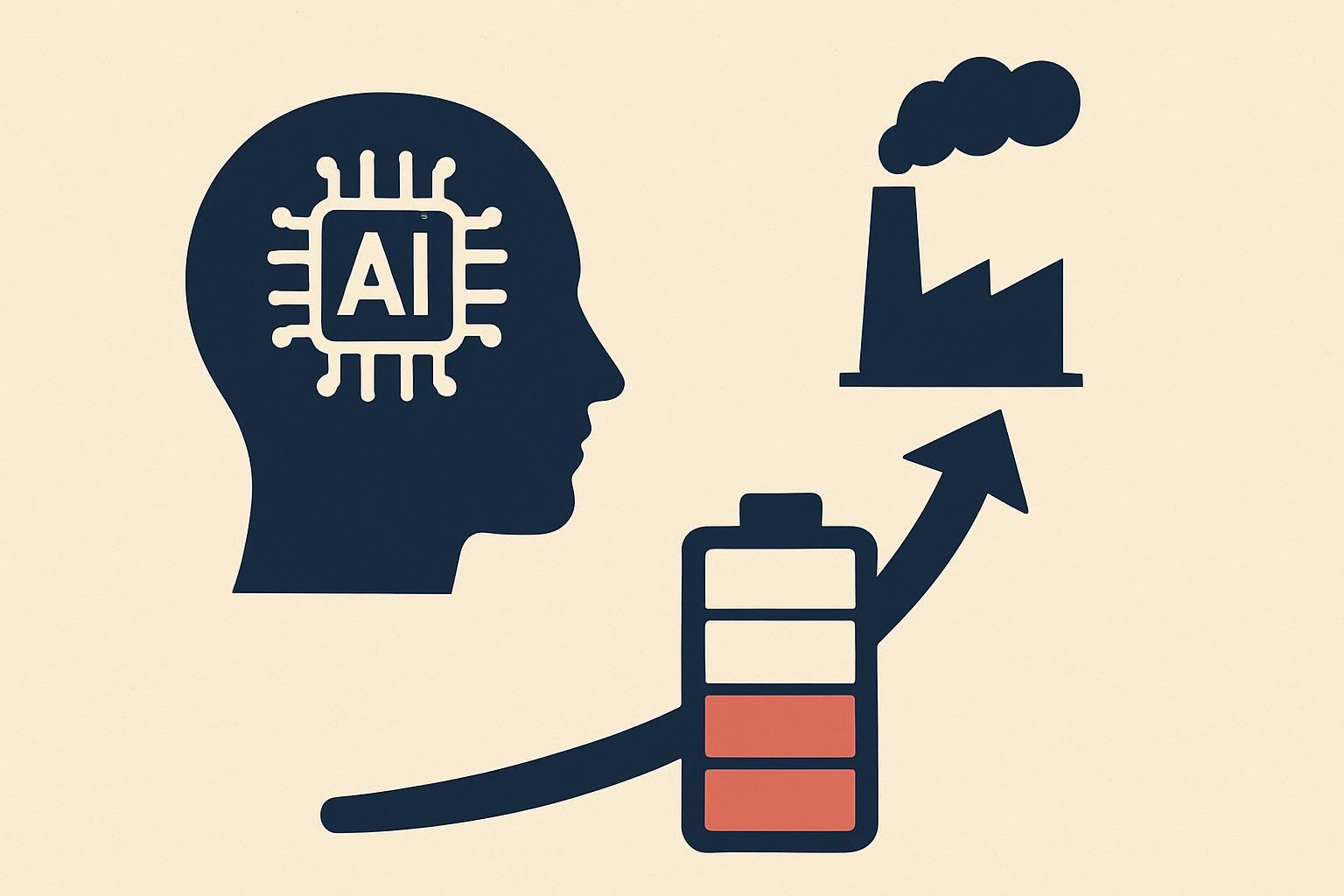
Electricity consumption tied to large AI models is rising faster than improvements in energy and water efficiency, according to recent corporate sustainability reports and independent estimates.
Electricity consumption is emerging as the clearest indicator of the rapid expansion of the AI sector — and a test of how long that growth rate can continue.
Why it matters
The industry's push toward ever-larger models has sparked debate about whether those models will deliver enough value to justify rising environmental and financial costs.
Recent developments
Google, Microsoft and Amazon highlighted improved energy and water efficiency in sustainability reports published in recent weeks. Those gains, however, are being outpaced by overall growth in energy use.
Key statistic
Google's electricity consumption rose by more than 140% between 2021 and 2025 — already exceeding the upper bounds of projected growth modeled in a 2023 paper by Alex de Vries-Gao (VU Amsterdam, founder of Digiconomist).
By the numbers
De Vries-Gao estimates that the additional combined electricity demand added by Google, Microsoft, Amazon and Meta between 2022 and 2025 is roughly twice New York City's annual electricity consumption. This scale of growth is evident across the industry.
The core debate
The large amount of energy required for AI raises the question whether the industry's emphasis on larger and larger models produces benefits that justify these growing resource demands.
What executives say
Kate Brandt, Google's chief sustainability officer, said: “We are deeply committed to responsibly managing the environmental footprint of our operations.”
Melanie Nakagawa, Microsoft's chief sustainability officer, said: “Our goal is not simply to slow the growth of environmental impacts... to reduce the intensity of each unit of growth over time, so that future growth really does become increasingly decoupled from that future impact.”
Boris Gamazaychikov, co-founder of Sustainable AI Group, noted that much of the industry operates on the assumption that increasing scale will lead to better performance and ultimately higher profits.
The counterpoint
Tech companies increasingly emphasize AI's potential to improve lives and reduce emissions. Google devoted a larger portion of this year's sustainability report to AI's environmental benefits, citing uses from autonomous vehicles to scaling solar power.
But de Vries-Gao and Gamazaychikov point out that many of the AI applications highlighted today rely on relatively narrow models, not the frontier models driving much of current data-center expansion. Companies argue that advances in frontier models will eventually enable many downstream applications.
Proposed measures
Gamazaychikov recommends that AI models disclose standardized energy-efficiency metrics, akin to fuel-economy ratings for cars, so customers can compare how much computing different tasks require. “You don't need a Hummer to go to the grocery store,” he said.
Economic implications
Environmental concerns may matter most through their economic consequences. Daron Acemoglu, an MIT economics professor and Nobel laureate, argues that if investment continues to outpace demand, the AI boom could slow on economic grounds.
Historical context
Some major earlier technological breakthroughs — canals, railroads, the internet — generated enormous investment booms, with capital poured into new infrastructure years before economic returns were clear. Analysts say the AI boom may be even more extreme than those earlier waves.
What to watch
Industry insiders argue that the next two to four years will be different and that the technology is exceptional enough to overturn past trends. Daron Acemoglu finds that not entirely convincing but does not rule it out.
Bottom line
The electricity required to power large AI models is rising faster than measured improvements in efficiency. That gap raises environmental, consumer information and economic questions that companies, researchers and regulators will need to address.
Related articles More from the section.

SAP considers cutting more than 10,000 jobs amid AI shift
SAP is considering eliminating more than 10,000 positions as it adapts its business to artificial intelligence, according to Bloomberg.
Industry · November 26, 2026
OpenAI employee saw potential for mathematical applications of the model early on
An OpenAI employee referred to in the text as Ven believed early on that the company’s model at the time might be capable of solving the Millennium Prize Problems.
Industry · November 26, 2026
GTA VI and Anthropic IPO Highlight Debate Over AI and Creative Work
The reported launch of Grand Theft Auto VI has renewed debate over whether AI can replicate the painstaking work behind ambitious video games.
